
Law for IT Professionals
IT Professional societies have struggled to identify a meaningful Body of Knowledge that should be mastered by all IT Professionals. The two leading US societies for IT Professionals, the ACM and the IEEE-CS, cooperated in the development of a major Computing Curriculum Report (CC2005). This report provides a useful graphical view of the “Problem Space of Computing”. They developed a two-dimensional model, with a theoretical-to-applied horizontal dimension, and five vertical areas of concentration. It was represented as:
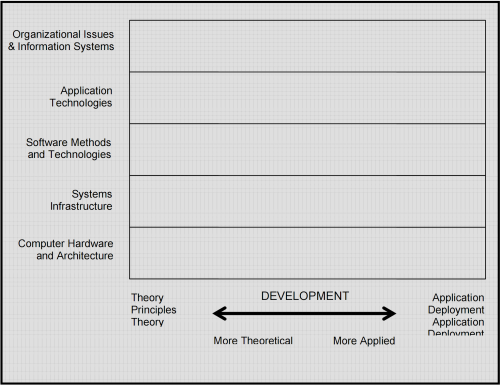
This model has been generally accepted and was subsequently used in several other curricular proposals. It's instructive to compare the coverage projected for Computer Engineering (CE) and for Information System (IS) programs:
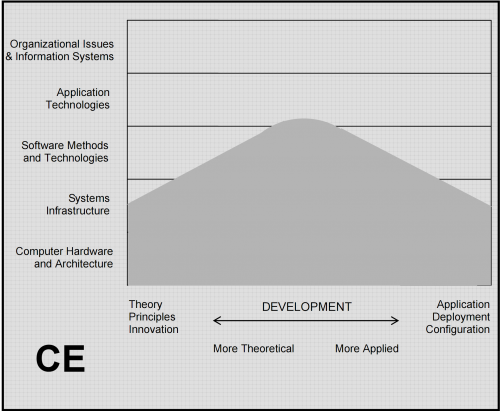
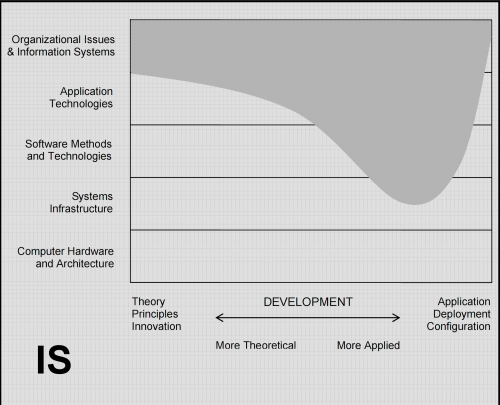
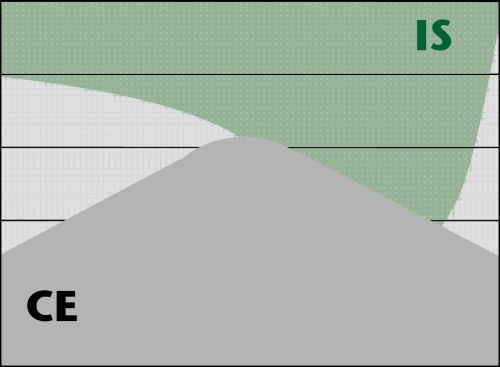 There is virtually no overlap. A composite image illustrates this lack of overlap. The CE program Body of Knowledge focuses on computer hardware, architecture, and system infrastructure. The IS program focuses on organizational issues, information systems, and application technologies. There is a small overlap in the systems methods and technologies area, but that hardly constitutes a meaningful Body of Knowledge mastery of which should be required of all IT Professionals. With little common Body of Knowledge mastery, it would still be reasonable to expect that graduates from both Computer Engineering and Information System programs to enter the IT Profession.
The Engineers faced a similar challenge almost from the beginning of their profession. There is no meaningful Engineering Body of Knowledge that should be mastered by all Engineers. Each sub-discipline within Engineering may have its own Body of Knowledge that should be mastered by the Engineers who practice in that sub-discipline, but there is no common Engineering Body of Knowledge that is relevant and important for all Engineering disciplines. Part of the response of the Engineers is to shift attention to the context of Engineering, specifically the legal and ethical context.
It makes sense to consider a similar shift in testing emphasis in IT. Would it not be useful to develop study materials and an examination for “Law for IT Professionals”? This could focus on Canadian Law particularly relevant for IT Professionals, but also consider relevant common law as it applies in our major trading partners. On one level, this would seem to be a highly ambitious undertaking. It would be expensive and time-consuming to develop our own study guide – the Engineers depend on a textbook developed specifically for them (Law for Professional Engineers: Canadian and International Perspectives, D.L.Marston, McGraw-Hill).
There is a promising alternative that it would make sense to consider. Canadian Schools of Business regularly offer Canadian Business Law courses. There are several textbooks which complete in this space, but The Law and Business Administration in Canada, (Smyth, Soberman, & Easson, Prentice-Hall), is successful and offers particularly interesting supporting materials. Three of the eight chapters in this text – Torts, Contracts, and Legal Environment for Business – appear to be directly relevant for IT Professionals. In addition, there are selected sections from other chapters that are relevant, e.g. Intellectual Property.
This would not cover all legal topics that might be important for a Canadian IT Professional, but it would provide a good foundation for any further exploration of Canadian or International Law that the IT Professional may require. It happens that this particular text on Canadian Business Law is accompanied by a most useful website: http://wps.prenhall.com/ca_ph_smyth_lawadminca_10/0,8234,1013581-main,00.html. For each section of the text, this site provides a number of pages that cover:
- Objectives, Outline, and Destinations
- Study Questions
- 5 Short Essay Questions based on the Learning Objectives
- 15 Multiple-Choice Questions
- 10 True/False Questions
- 2-3 Internet Application Questions
Once the sections to study have been identified, the questions available on the site provide a pool of questions that might be used to construct sample examinations. The Instructor Material (restricted access) may contain questions that could be used in actual examinations. Prentice-Hall Canada has been asked if restricted access to that material can be provided.
A small panel of experts from within the Canadian IT Profession and the Canadian Legal Profession should be able to rapidly identify the sections from this text that need to be covered. All that remains is to develop an appropriate database of questions that could be asked and a process that could be used to deliver the test. My assumption is that the test should be a timed, open book exercise. All we would need is a physical location that was prepared to identify the people taking the test. The actual testing could be handled by one of the popular e-learning packages – Moodle would be a natural candidate.
Those who successfully complete the examination should be awarded a “Certificate of Completion – Law for IT Professionals Examination”. Such a certificate might be offered by the Canadian Information Processing Society (http://www.cips.ca) or by the Information and Communications Technology Council of Canada (http://www.ictc-ctic.ca). Passing such a course would be potentially quite useful for recent immigrants or recent graduates from academic computing programs. The exam could be successful enough that it becomes a money maker for the organization that mounts it.
 Print
Print Email
Email